
GAB/BAG integrated Model
Enhancing Trust, Traceability & Operational Excellence
The GAB/BAG Integrated Model is a research-driven framework that integrates Generative AI (GAB) with Blockchain-based Assurance & Governance (BAG) to strengthen operational efficiency, enhance traceability, and reinforce risk management across the banking value chain.
This page presents the conceptual foundations, academic positioning, and practical implications of the GAB/BAG Integrated Model as a working research framework.
Research Status
The GAB/BAG Integrated Model is currently developed as a conceptual and architectural research framework focused on decision traceability and governance in private banking.
Empirical validation and applied pilots are positioned as subsequent research phases.
What is the GAB/BAG Integrated Model?
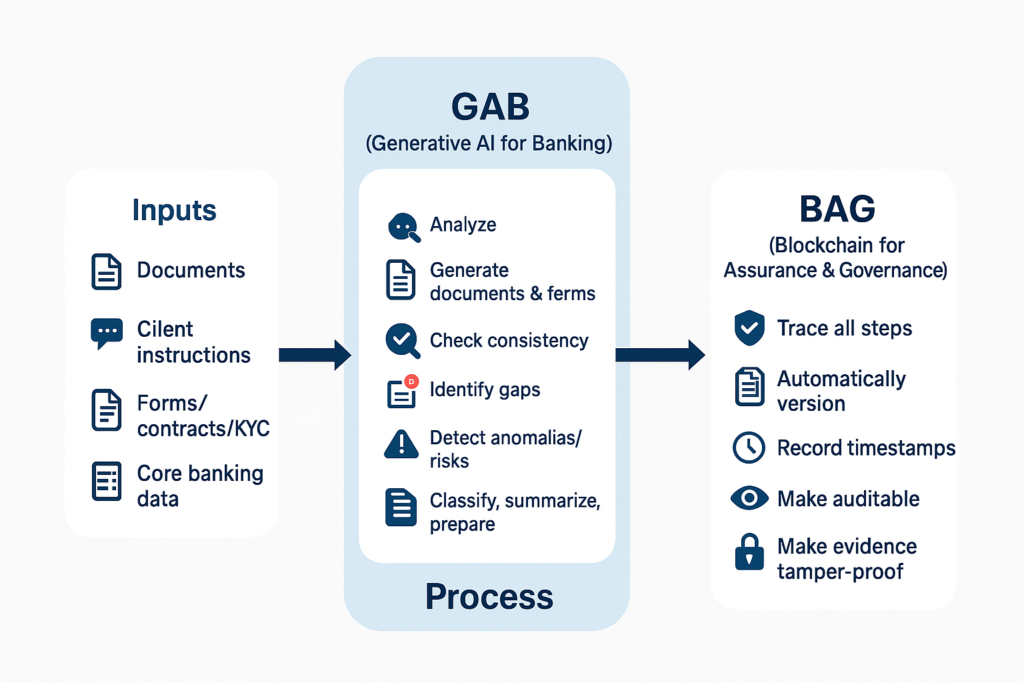
The GAB/BAG Integrated model is a research-driven dual-layer framework designed to enhance operational reliability, efficiency, traceability, and auditability across front-to-back banking processes. It combines:
- GAB – Generative AI for Banking: workflow automation, exception detection, knowledge extraction, risk monitoring.
- BAG – Blockchain for Assurance & Governance: immutable evidence, audit-ready logs, transparency, operational resilience.
GAB – Generative AI for Banking
GAB uses structured AI components to analyze workflows, detect anomalies, automate repetitive tasks, extract knowledge, and reinforce operational efficiency across front-to-back banking activitives.
- Process automation
- Error & anomaly detection
- Knowledge extraction
- Operational risk monitoring
- Decision support
BAG – Blockchain Assurance & Governance
BAG provide immutable, audit-ready evidence across operational value chain, improving transparency, compliance, and resilience.
- Immutable audit logs
- Real-time traceability
- Regulatory alignment
- Evidence integrity
- Operational resilience
Research Methodology and Design
This research adopts a design science–informed qualitative and conceptual methodology focused on governance, decision traceability, and operational accountability in Swiss private banking. The study is exploratory in nature and aims to develop and structure the GAB/BAG Integrated Model as a meta-level governance framework rather than to test predefined hypotheses. The research design combines conceptual model construction, regulatory and institutional analysis, and process-oriented systems thinking, enabling the progressive alignment of academic theory, supervisory expectations, and real-world banking operations without reliance on institution-specific data or proprietary systems.
The analytical approach is based on structured conceptual mapping and traceability analysis, drawing on peer-reviewed academic literature, regulatory standards, and anonymised professional observations. Validation is conducted through theoretical coherence, regulatory consistency, and functional robustness across multiple operational scenarios, in line with doctoral-level research in management and applied governance. The methodology intentionally prioritises conceptual depth over empirical generalisation, ensuring ethical compliance, institutional neutrality, and the preservation of the model’s originality and intellectual property.
Working Paper (2025) – version 1.3
An Integrated AI-Blockchain Governance Framework for Operational Resilience in Private Banking
This working paper presents a conceptual, practice-based research framework developed as part of an ongoing Executive Doctorate in Business Administration (DBA).
Version 1.3 introduces minor editorial and academic positioning adjustments aligned with a practice-based DBA research trajectory. The conceptual framework remains unchanged.
The paper is shared for academic dissemination and scholarly feedback. Empirical validation, operationalization, and implementation details are intentionally excluded at this stage and reserved for subsequent doctoral research.
why the GAB/BAG Model Matters
The GAB/BAG Integrated Model addresses a growing need in banking operations: combining intelligent automation with trustworthy, audit-ready evidence. It is designed to support both day-to-day efficiency and long-term regulatory assurance.
- Bridge AI-driven automation with robust governance and auditability.
- Reduces operational risk by improving traceability across front-to-back processes.
- Generates structured, reusable evidence for regulators, auditors, and internal control.
- Provides a research-backed framework that can be extended in a DBA/PhD context.
Key Capabilities of the GAB/BAG Model
Workflow & Exception Management
GAB orchestrates front-to-back workflows, flags anomalies, and supports exception handling with contextual recommendations.
Knowledge Extraction
Unstructured documents, emails, and procedures are transformed into structured, queryable knowledge assets.
Operational Risk Insights
Recurrent incidents and control weaknesses can be detected earlier and documented consistently across teams.
Immutable Evidence Layer
BAG logs critical events and approvals on an immutable ledger, creating audit-ready evidence across the value chain.
Traceability & Transparency
Stakeholders can trace who did what, when, and under which rule set, without exposing sensitive client data.
Regulatory & Audit Alignment
The model is designed to be mapped to frameworks such as operational resilience, internal control systems, and audit standards.
About the Author
Hervé Racordon is a senior banking professional specialized in operational processes, internal control, and front-to-back coordination. Building on more than 25 years of experience in Swiss private banking, he is developing the GAB/BAG Integrated Model as part of a research-driven journey towards a future DBA/PhD.
- Extensive experience in Swiss private banking operations
- Focus on AI, automation, and operational resilience
- Creator of the GAB/BAG Integrated Model
- ORCID:
0009-0008-9382-3191

