
Decision Traceability as an Institutional Artefact:
A Conceptual Illustration of the GAB/BAG Model
Context
Decision traceability, when treated as a governance primitive, requires more than conceptual recognition.
To become institutionally meaningful, it must be materially instantiated in a form that supports auditability, accountability, and long-term defensibility.
This Insight provides a conceptual illustration of how such a governance primitive may be translated into a decision artefact, using the GAB/BAG Integrated Model as an explanatory framework.
Core Concept
At the core of governance-by-design lies the distinction between decision formation and decision anchoring.
The GAB/BAG model illustrates this distinction by separating analytical intelligence from institutional assurance.
Within this conceptual architecture:
- the GAB layer (AI) contributes to decision formation by generating contextualised analytical inputs;
- the BAG layer (Blockchain) contributes to governance by anchoring decisions as immutable artefacts.
Decision traceability thus emerges not as a technical feature, but as the result of an explicit architectural separation between intelligence, authority, and accountability.
Analytical Perspective
From an analytical standpoint, the GAB/BAG model reframes traceability as a property of the decision system rather than of individual models.
AI-based analysis informs decision-making without assuming responsibility for the decision itself.
The governance artefact anchored in the BAG layer captures the outcome, context, and constraints of a decision ex post.
This artefact enables reconstruction and review without conflating analytical reasoning with institutional authority.
It is this separation that allows traceability to function as a governance primitive rather than as a form of technical surveillance.
Structural Implications for Governance
Conceptually illustrating decision traceability through the GAB/BAG model highlights several governance implications.
First, responsibility remains clearly human and institutional, even in AI-assisted environments.
Second, auditability is achieved through artefact design rather than behavioural monitoring.
Third, governance shifts from controlling models to structuring decision lineage.
These implications suggest that traceability must be embedded at the architectural level, rather than retrofitted after decisions have been executed.
Why it matters for private banking
In private banking, decisions often require justification long after execution.
By materialising decisions as governance artefacts, institutions strengthen their ability to demonstrate responsible conduct, manage disputes, and engage credibly with supervisory authorities.
The GAB/BAG illustration shows how traceability can be embedded by design without undermining fiduciary accountability or analytical flexibility.
Related Concepts and Research
Related concepts
- Decision Traceability
- Governance-by-Design
- Decision Artefact
Related research
- GAB/BAG Integrated Model – Working Paper
- Research Notes on Decision Traceability and Governance
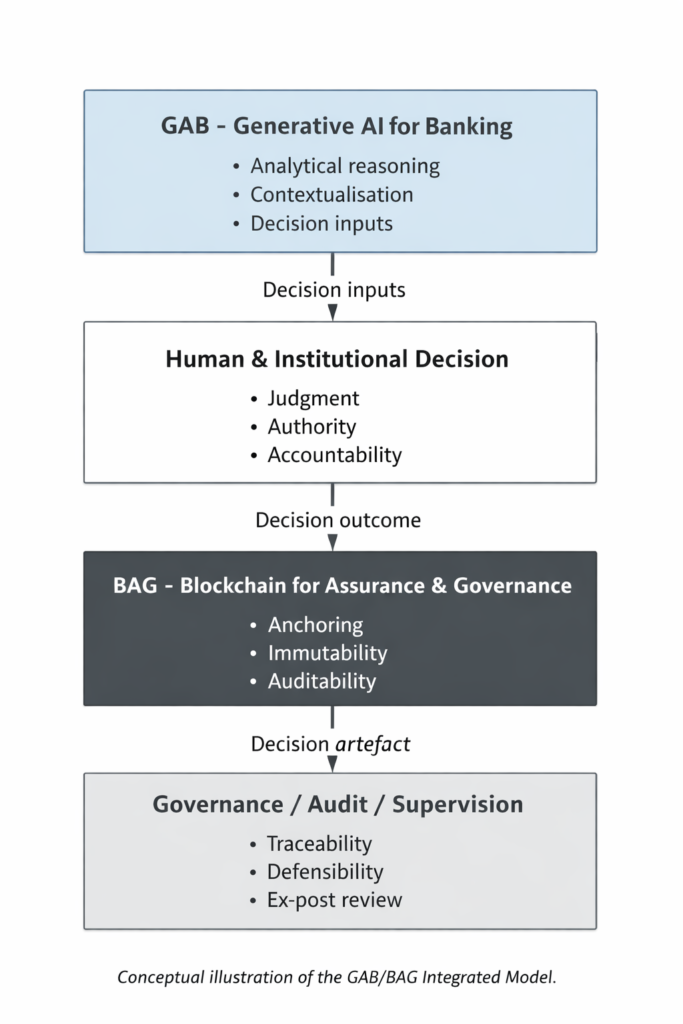
Illustrative conceptual representation of decision traceability as a governance primitive.
The GAB layer (AI) contributes analytical inputs to decision formation, while the BAG layer (Blockchain) anchors the final decision as an immutable governance artefact.
This diagram is conceptual and does not represent a technical implementation.
Indicative Academic References
Floridi, L., Cowls, J., Beltrametti, M., et al. (2018). AI4People—An Ethical Framework for a Good AI Society. Minds and Machines, 28, 689–707.
“This insight is developed as a companion to ongoing doctoral research. It does not constitute a pre-publication of submitted academic work”.

